Choosing between 6061 and 7075 aluminum is the single most common material decision we review with mechanical engineers and B2B buyers during quoting. On our shop floor in China, 6061-T6 and 7075-T6 account for the vast majority of custom aluminum CNC parts we machine every week—yet specifying the wrong grade routinely wastes 30% to 80% of a part’s budget or causes unexpected anodizing color mismatches, thread wear, or thin-wall warpage. In this engineering guide, we break down 6061 vs. 7075 aluminum from a direct CNC factory perspective, covering not only standard mechanical properties but also the real shop-floor trade-offs—such as elastic stiffness myths, T651 stress-relieved plate selection, anodizing bath behavior, thermal conductivity, and true machined part cost.
Quick Engineering Comparison: 6061-T6 vs. 7075-T6 Aluminum
If you need a rapid engineering decision before diving into the shop-floor details, 6061-T6 is the optimal choice for roughly 80% of custom CNC housings, brackets, heat sinks, and anodized assemblies due to its lower raw billet cost, superior corrosion resistance, higher thermal conductivity, and uniform cosmetic anodizing. By contrast, 7075-T6 is the right upgrade when finite element analysis or physical load testing proves that a compact, weight-limited component requires nearly double the yield strength (503 MPa vs. 276 MPa) and higher fatigue resistance without moving to heavier steel or costlier titanium.
| Engineering Property | 6061-T6 Aluminum | 7075-T6 Aluminum | Shop-Floor Impact |
|---|---|---|---|
| Primary Alloying Elements | Magnesium (0.8–1.2%) & Silicon (0.4–0.8%) | Zinc (5.1–6.1%), Magnesium (2.1–2.9%) & Copper (1.2–2.0%) | Copper and zinc give 7075 high strength but lower corrosion resistance |
| Ultimate Tensile Strength | ~310 MPa (45,000 psi) | ~572 MPa (83,000 psi) | 7075 handles ~85% higher peak tensile stress before fracture |
| Tensile Yield Strength | ~276 MPa (40,000 psi) | ~503 MPa (73,000 psi) | 7075 resists permanent bending at ~1.8× higher load than 6061 |
| Modulus of Elasticity (Stiffness) | 68.9 GPa | 71.7 GPa | Only ~4% difference; switching to 7075 does not stop elastic flex |
| Brinell Hardness | ~95 HB | ~150 HB | 7075 resists denting, thread stripping, and wear better than 6061 |
| Density | 2.70 g/cm³ | 2.81 g/cm³ | 7075 is ~4% heavier for the exact same CAD geometry |
| Thermal Conductivity | ~167 W/m·K | ~130 W/m·K | 6061 transfers heat ~28% faster, making it superior for heat sinks |
| CNC Machinability | Excellent (slightly gummier chip) | Very Good (crisp, short-breaking chips) | 7075 produces cleaner edges; 6061 allows higher raw removal rates |
| Anodizing Appearance | Uniform clear, matte black & bright colors | Acceptable, but clear coat pulls slightly yellowish/dull | Never mix 6061 and 7075 in the same cosmetic anodized assembly |
| Weldability | Very Good (TIG / MIG with 4043 or 5356) | Poor (prone to hot cracking; use fasteners) | Specify 6061 if any post-machining welding or brazing is required |
| Raw Billet Cost | Baseline (1.0×) | ~1.8× to 2.5× higher | Total finished part price increases 15%–90% depending on billet weight |
1. Alloy Chemistry and Why 7075 Is Nearly Twice as Strong as 6061
The mechanical gap between 6061 and 7075 aluminum comes directly from their precipitation-hardening chemistry. Aluminum 6061 belongs to the 6xxx series, where magnesium and silicon form magnesium silicide (Mg₂Si) precipitates during T6 heat treatment. This microstructure produces a versatile, ductile alloy with a typical yield strength of 276 MPa, strong natural oxide corrosion protection, and forgiving forming and welding behavior. When we machine custom 6061 aluminum CNC parts, the alloy handles aggressive roughing while keeping internal stress manageable across general-purpose housings, mounting plates, and fixtures.
Aluminum 7075 belongs to the 7xxx series, using zinc (5.1%–6.1%), magnesium (2.1%–2.9%), and copper (1.2%–2.0%) to form dense eta-prime strengthening precipitates during T6 aging. Those precipitates elevate 7075-T6 yield strength to approximately 503 MPa and Brinell hardness to 150 HB—comparable to many structural low-carbon steels at roughly one-third the weight. In our aluminum alloy CNC machining work for robotics actuators, drone propulsion hubs, and high-load motorsport brackets, 7075-T6 lets engineers shrink cross-sections without risking permanent plastic deformation under shock loads.
However, higher strength comes with reduced ductility and toughness trade-offs that engineers must account for in CAD. Aluminum 6061-T6 typically exhibits 12% to 17% elongation at break, meaning an overloaded bracket tends to bend visibly before snapping. Aluminum 7075-T6 exhibits lower elongation (roughly 11% in thin stock and less in thick plate) and higher notch sensitivity, which means sharp internal corners or un-chamfered stress risers can initiate fatigue cracks faster in 7075 than in 6061. On every 7075 drawing we review, we recommend generous internal fillet radii (at least R1.5 mm to R3.0 mm where geometry permits) to protect fatigue life.
2. Strength vs. Stiffness: The Young’s Modulus Myth We See Every Week
One of the most expensive misconceptions we encounter during DFM reviews is engineers switching from 6061-T6 to 7075-T6 to stop a bracket or sensor plate from flexing. Strength (yield stress) measures how much load a part can carry before permanently bending, whereas stiffness (Young’s modulus of elasticity) measures how much a part deflects elastically under a given load. Aluminum 6061-T6 has a modulus of elasticity of 68.9 GPa, while 7075-T6 has a modulus of 71.7 GPa—a stiffness gain of barely 4%.
In practical mechanical design, that 4% difference is almost unnoticeable on an optical bench, robotics arm, or alignment fixture. If a 6061-T6 cantilever bracket deflects 0.100 mm under a 50 N sensor load, machining the exact same geometry out of 7075-T6 will still deflect approximately 0.096 mm while doubling raw material cost. Whenever a customer tells us their 6061 prototype “felt too flexible” during testing, we advise keeping 6061-T6 and increasing wall thickness by 15%–20% or adding a small stiffening rib—because bending stiffness scales with the cube of section thickness, delivering far greater rigidity at a fraction of the cost of 7075.
Where 7075-T6 genuinely wins is when a part is already stiff enough for its application, or operates inside an unchangeable space envelope, but experiences high localized peak loads, bearing press-fit stresses, or cyclic fatigue near 250–400 MPa that would permanently yield 6061-T6. Distinguishing between a stiffness-limited design (fix with geometry in 6061) and a strength-limited design (upgrade to 7075) is the fastest way to optimize both part performance and CNC budget.
3. Shop-Floor CNC Machinability, Chip Control, and Why T651 Plate Prevents Warpage
Both 6061 and 7075 rank among the most machinable metals in any CNC shop, but they behave noticeably differently on our 3-axis and 5-axis CNC machining centers. Because 6061-T6 is softer and slightly more ductile, it has a greater tendency to form long, stringy chips and built-up edge (BUE) on cutting flutes if spindle speeds or coolant concentration drop. To achieve a crisp Ra 0.8–1.6 µm surface finish on 6061-T6, our machinists run polished 3-flute high-helix uncoated or ZrN-coated carbide end mills with high-pressure flood coolant to evacuate chips cleanly from deep pockets.
Aluminum 7075-T6 actually produces shorter, cleaner-breaking chips and crisper machined edges than 6061-T6 because of its higher hardness (150 HB vs. 95 HB). Features like micro-chamfers, fine threads, and thin O-ring lands come off the spindle with minimal burring in 7075-T6, and the alloy resists tool-push deflection slightly better during light finish passes. However, 7075’s higher hardness also accelerates flank wear on carbide tools and increases cutting forces slightly, so we reduce radial step-overs slightly compared to 6061 roughing to maintain consistent surface finish across multi-hundred-piece runs.
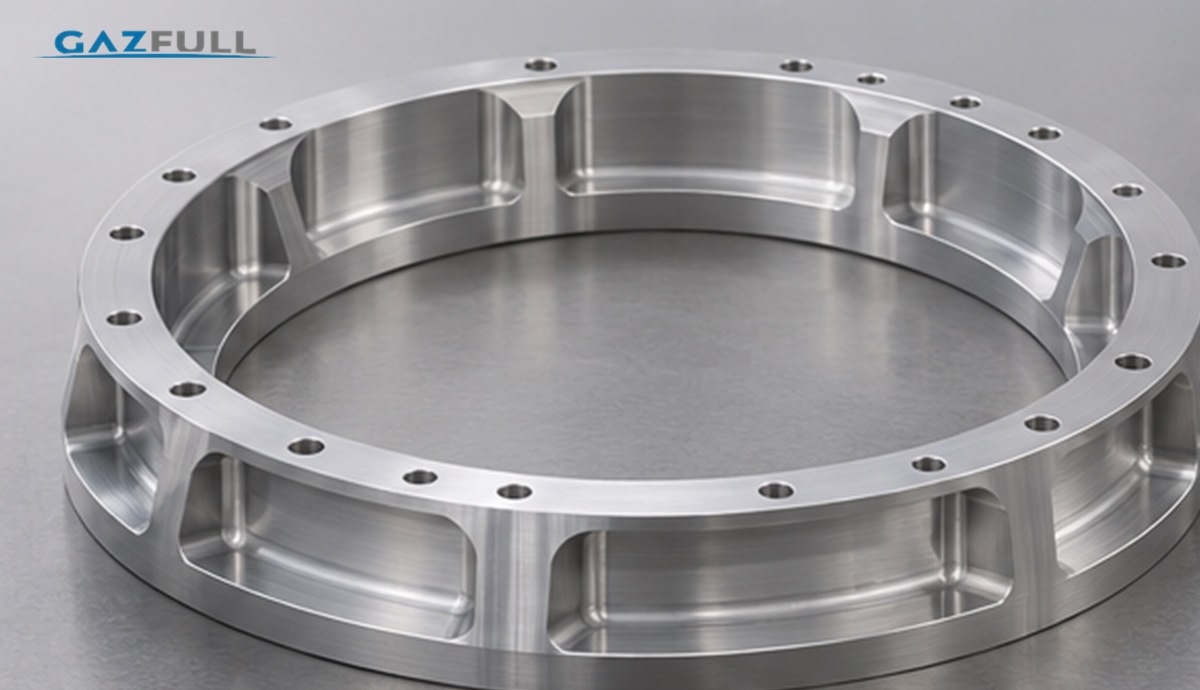
A critical detail omitted by most online comparison charts is raw stock temper: specifically, T6 vs. T651. Standard extruded or rolled T6 plate carries significant internal residual stress locked inside from quenching. When we hog out 70% to 85% of a billet to machine a deep thin-wall CNC aluminum frame or flat mounting plate, releasing that trapped stress causes the part to spring out of flatness (“potato-chipping”) the moment we open the vise—and 7075-T6 can warp aggressively if machined from un-relieved stock.
To prevent post-clamping distortion in our China workshop, we source mechanically stretched, stress-relieved 6061-T651 and 7075-T651 plate for flat, heavily pocketed, and tight-tolerance geometries. On thin walls down to 0.5 mm–0.8 mm, we combine T651 stock with symmetrical roughing on both sides, unclamp the workpiece to allow residual stress relaxation, and then run light climb-milling finish passes using custom contoured soft jaws. Specifying T651 on your 2D drawing whenever flatness is tighter than 0.05 mm saves both scrap risk and rework time.
4. Anodizing Color Match, Coating Buildup, and Selective Masking
Surface finishing is where 6061-T6 holds a decisive practical advantage over 7075-T6 for customer-facing hardware. During sulfuric acid anodizing (Type II decorative or Type III hardcoat), aluminum forms a controlled porous aluminum oxide layer that absorbs dye and seals shut. Because 6061-T6 has low copper and zinc content, its oxide layer grows uniformly transparent, yielding bright, consistent clear anodizing, deep jet-black matte finishes, and vibrant red, blue, or gold dyed coatings across large batches.
By contrast, the high zinc (5.6%) and copper (1.6%) content in 7075-T6 disrupts uniform oxide clarity during anodizing. Clear Type II anodizing on 7075-T6 frequently develops a slightly dull, warm-yellowish or greyish tint compared to the bright silver look of clear-anodized 6061-T6. Even in black Type II or Type III hardcoat baths, 7075-T6 absorbs dye at a different rate than 6061-T6 and often shifts toward a slightly warmer charcoal or brownish-black cast under bright inspection lights. For this reason, we strongly advise engineers never to mix a 6061 lid with a 7075 base in the same cosmetic anodized enclosure assembly.
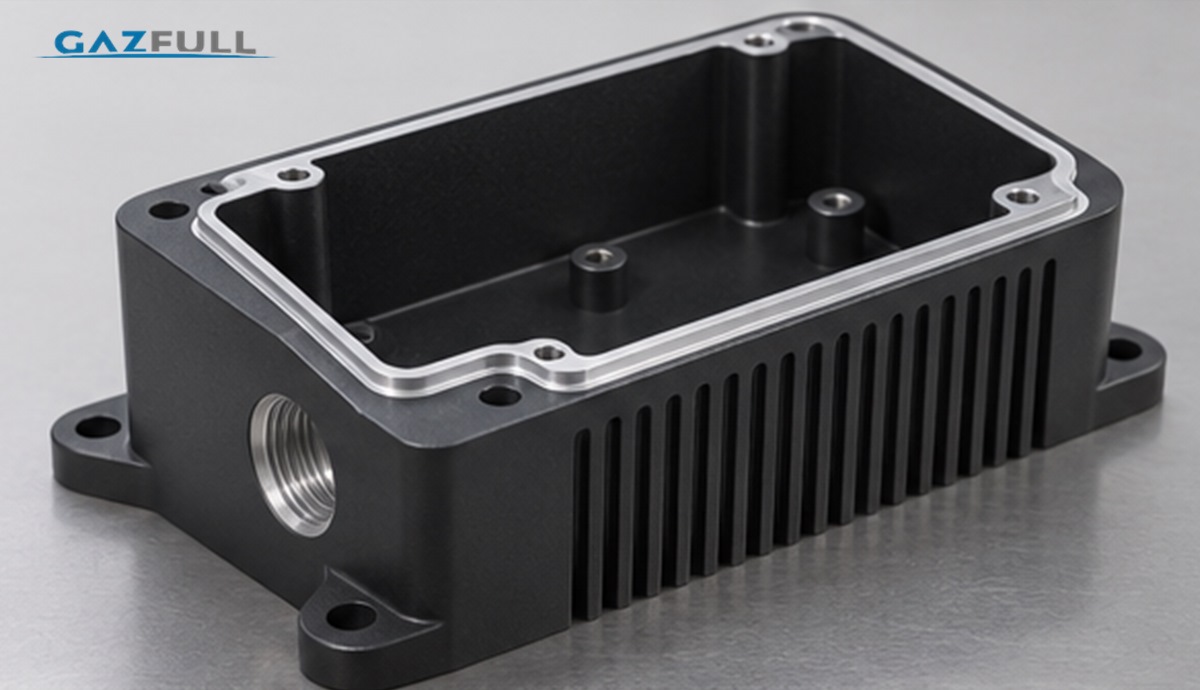
Engineers must also account for anodizing dimensional buildup on tight mating features regardless of alloy. Standard Type II anodizing adds approximately 5 to 12 µm of total oxide thickness per surface (half penetrating into the metal, half building outward), while Type III hard anodizing adds 25 to 50 µm per surface—enough to turn an H7 dowel bore or fine M3 thread into an interference fit. When we manage surface finishing for CNC aluminum parts, we review your 2D drawing before machining to either plug threaded holes, mask tight bearing bores and EMI grounding pads with silicone plugs and lacquer, or pre-machine critical bores oversize so final post-anodize dimensions land squarely inside tolerance.
For exterior CNC machined aluminum housings and precision optical mounts requiring low reflectivity, fine glass-bead blasting followed by matte black Type II anodizing on 6061-T6 delivers the cleanest, most uniform appearance at the lowest cost. If your 7075-T6 part operates in humid or marine conditions where stress corrosion cracking is a concern, we recommend Type III hard anodizing or trivalent chromate conversion (Alodine) for reliable corrosion protection.
5. Thermal Conductivity, Corrosion Resistance, and Weldability
For thermal management applications, 6061-T6 is technically superior to 7075-T6—not merely a cheaper substitute. Aluminum 6061-T6 delivers a thermal conductivity of approximately 167 W/m·K, whereas 7075-T6 drops to roughly 130 W/m·K due to its heavier zinc and copper alloying elements scattering heat-carrying electrons. That 28% conductivity advantage makes 6061-T6 (alongside 6063 when extrudability or even higher ~200 W/m·K conductivity is needed) our go-to aluminum alloy for custom CNC machined heat sinks, LED driver housings, laser chiller blocks, and power electronics cold plates.
Corrosion resistance follows a similar split. Aluminum 6061-T6 forms a stable, passive oxide film that resists atmospheric moisture, industrial washdowns, and general outdoor exposure even in bare or chromated form. Aluminum 7075-T6 contains copper that creates microscopic galvanic cells within the alloy grain boundaries, making bare 7075 significantly more vulnerable to pitting corrosion and Stress Corrosion Cracking (SCC) when exposed to sustained tensile stress in humid or salt-laden air. If a high-strength 7075 component must operate outdoors or in coastal/medical washdown environments, specifying protective anodizing or switching to the over-aged 7075-T73 temper (which trades ~12% yield strength for drastically improved SCC resistance) is essential.
Weldability is a binary decision point between the two grades. Aluminum 6061-T6 is readily TIG- and MIG-weldable using 4043 or 5356 filler rod (keeping in mind that welding softens the heat-affected zone back toward T4 properties unless post-weld aged). Aluminum 7075-T6 is classified as non-weldable for structural production because its high zinc-copper chemistry suffers severe solidification cracking in the weld pool. Whenever a customer’s assembly requires welded bosses, vacuum-tight seam welds, or brazed cooling covers, 6061-T6 is mandatory; 7075-T6 assemblies must be designed around mechanical fasteners, precision dowel pins, or structural adhesives.
6. Thread Durability, Galling, and When to Install Helicoil Inserts
Threaded holes are often the first feature to fail in serviceable aluminum equipment, yet thread performance rarely appears in generic 6061 vs. 7075 comparisons. Because 6061-T6 has a Brinell hardness of 95 HB, direct-tapped aluminum threads work reliably for permanent or infrequently opened covers—provided thread engagement depth is at least 1.5× to 2.0× the nominal screw diameter. However, if field technicians repeatedly tighten and remove stainless steel bolts from a 6061-T6 housing or test fixture, the softer aluminum flanks can wear or strip after 10 to 20 service cycles.
Aluminum 7075-T6’s higher hardness (150 HB) provides noticeably stronger shear resistance on direct-tapped threads, allowing slightly shorter engagement lengths (1.2× to 1.5× diameter) in compact aerospace or robotics parts. Even so, mating bare stainless steel bolts into bare aluminum threads under high torque can still cause galling over time in either alloy. In our shop, whenever a 6061-T6 or 7075-T6 part undergoes frequent assembly, carries high clamping preload, or serves as a precision production fixture, we recommend installing 304 stainless steel Helicoil (wire thread inserts) or Keensert bushings—which we tap and install in-house before shipping.
7. True CNC Cost Breakdown: Billet Price vs. Finished Part Price
Many buyers assume that because 7075-T6 raw bar or plate costs 1.8× to 2.5× more per kilogram than 6061-T6, the finished CNC machined part will automatically cost twice as much. On our quoting desk, the real price delta depends heavily on the ratio of raw material weight to total spindle time, plus batch quantity and finishing complexity.
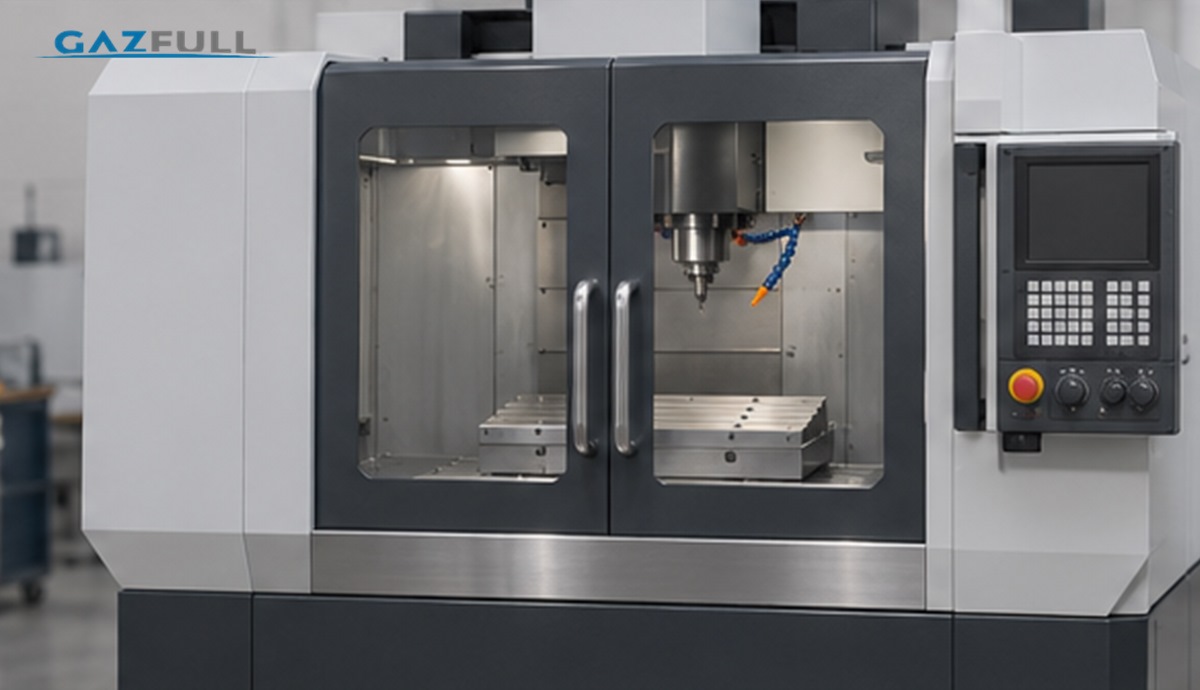
Consider two real-world part archetypes we quote regularly in our China CNC workshop:
- Archetype A — Compact, High-Complexity 5-Axis Part (Low Material Weight): Imagine a 45 × 45 × 25 mm robotics sensor bracket requiring 5-axis contouring, small blind bores, and CMM verification. Raw aluminum billet accounts for only ~12% of total manufacturing cost, while CAM programming, setup, 5-axis spindle time, and inspection account for ~88%. Switching this part from 6061-T6 to 7075-T6 typically raises the total finished part price by only 15% to 25%.
- Archetype B — Large, Deeply Pocketed Billet Enclosure (High Material Weight): Imagine a 260 × 180 × 65 mm electronics housing hogged out of a heavy solid aluminum plate where 80% of the billet becomes chips. Here, raw stock accounts for 45% to 55% of total cost. Switching this housing from 6061-T6 to 7075-T6 can increase the total finished part price by 60% to 90%—making 6061-T6 the clear economic winner unless extreme structural loads demand 7075.
Batch size also shifts alloy availability and cost. We stock standard 6061-T6/T651 bars and plates in almost every metric and imperial thickness, enabling rapid 3–5 business day prototype starts with minimal material waste. While we also stock popular 7075-T6/T651 sizes, unusual thick 7075 plate dimensions occasionally require larger cut-to-size minimum stock purchases for 1-off prototypes, which can add 1–2 days to lead time and raise single-piece prototype cost. Sharing both prototype quantity and expected production volume in your RFQ lets us optimize stock nesting from day one.
8. Holding ±0.005 mm Tolerances and CMM Verification on Both Alloys
Both 6061-T6 and 7075-T6 are capable of holding extreme CNC precision when machined with proper thermal and fixturing discipline. Our standard general machining tolerance for both alloys follows ISO 2768-f (±0.025 mm), while critical bearing seats, optical datum bores, and locating dowel holes are routinely held down to ±0.005 mm through our tight tolerance CNC machining workflow.
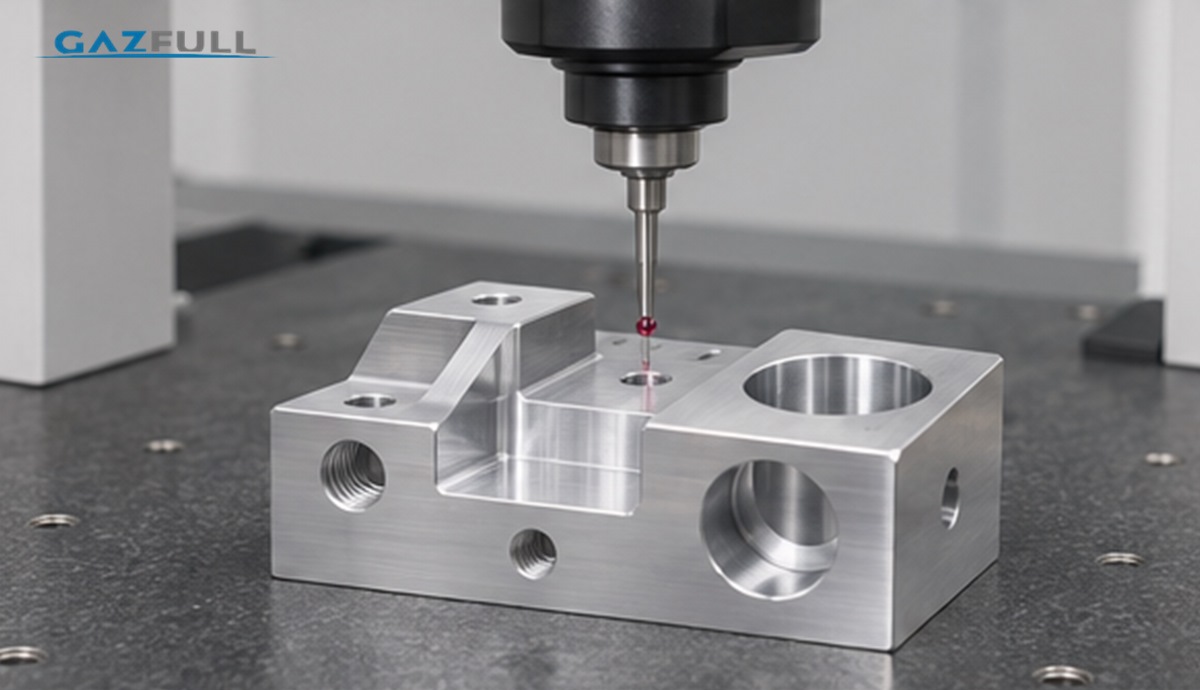
Because aluminum has a relatively high coefficient of thermal expansion (~23.6 µm/m·K for 6061 and ~23.4 µm/m·K for 7075—nearly twice that of carbon steel), a 100 mm aluminum part expands by roughly 0.024 mm for every 10 °C temperature swing. To ensure our outgoing dimensions match your incoming QC lab, we allow tight-tolerance 6061 and 7075 parts to thermally stabilize inside our temperature-controlled metrology room before measuring critical datums on our bridge Coordinate Measuring Machine (CMM). Reviewing our CNC machining tolerances guide before releasing your 2D drawing helps keep ±0.005 mm callouts focused strictly on functional mating surfaces rather than non-critical outer walls.
9. Practical Alloy Selection Matrix: Which Aluminum Should You Specify?
Before exporting your STEP model and 2D PDF drawing for quotation, run your part through our shop-floor selection matrix below to lock in the most cost-effective alloy:
| Application / Requirement | Recommended Alloy | Engineering Rationale |
|---|---|---|
| Electronics enclosures & housings | 6061-T6 / T651 | Superior cosmetic black/clear anodizing, lower billet cost, better heat dissipation |
| CNC heat sinks & cold plates | 6061-T6 | 28% higher thermal conductivity (167 vs. 130 W/m·K) than 7075 |
| High-load robotics joints & UAV hubs | 7075-T6 / T651 | ~1.8× higher yield strength (503 MPa) resists shock loads in compact envelopes |
| Optical mounts & alignment brackets | 6061-T651 (or 7075 if load-limited) | Clean matte black anodizing with minimal glare; T651 prevents flatness drift |
| Welded frames or brazed manifolds | 6061-T6 | 7075 is prone to hot cracking during welding and should never be structurally welded |
| High-wear cam followers, gears & clevises | 7075-T6 + Type III Hard Coat | 150 HB core hardness + hard anodizing resists surface galling and fatigue |
| Marine / high-humidity exposed brackets | 6061-T6 (anodized) | Far superior resistance to pitting and Stress Corrosion Cracking (SCC) |
10. Stock Forms, Lead Times, and Scaling from Prototype to Production
Alloy selection does not stop at mechanical datasheets—it directly shapes how smoothly your project scales from a single functional prototype to repeat production batches of 500 or 5,000 parts. Aluminum 6061-T6 and 6061-T651 are globally stocked in round bar, hex bar, flat bar, square tubing, precision-ground tooling plate, and custom extrusions. When you move from rapid CNC prototyping into repeat production machining, 6061 allows seamless transition into near-net-shape custom extruded profiles that cut raw billet waste by 40% to 65% while keeping the exact same alloy chemistry and anodizing behavior.
Aluminum 7075-T6 and 7075-T651 are primarily stocked as aerospace-grade rolled plate and extruded round or rectangular bar, with far fewer standard hollow tube or thin-profile options. Because 7075 has higher flow stress during hot extrusion, custom near-net extrusions in 7075 require higher minimum mill runs and stricter extrusion tolerances than 6061. For low- to mid-volume production runs (10 to 1,000 pieces), machining 7075 from solid T651 plate or bar remains the most economical and dimensionally repeatable route, whereas high-volume 7075 programs often justify forged blanks to reduce chip volume and align grain flow along primary load paths.
Traceability and material certification are equally straightforward when requested upfront. For both 6061 and 7075 orders, we source certified mill stock and can supply EN 10204 3.1 Material Test Reports (MTRs) documenting exact chemical composition, heat-lot number, tensile yield strength, and temper verification. When your project enters pilot validation or medical/robotics qualification, locking in a single certified heat lot across your batch ensures uniform machinability, predictable stress behavior, and consistent anodizing color from the first piece to the last.
11. RFQ Drawing Checklist: 6 Details to Confirm Before Quoting 6061 or 7075
A clear 2D PDF drawing paired with a clean 3D STEP model eliminates guesswork, accelerates quoting, and prevents costly miscommunication between engineering and the shop floor. Before submitting your aluminum CNC parts for quotation, verify these six specifications on your drawing package:
First, state the exact alloy and temper (such as 6061-T651 or 7075-T651) rather than generic “Aluminum.” Leaving temper unspecified forces a shop to guess whether standard extruded T6 bar or stress-relieved T651 plate is required, which can directly impact flatness on thin-walled housings and large optical baseplates.
Second, separate functional datums from general clearances. Applying a blanket ±0.01 mm tolerance across an entire aluminum housing inflates spindle time and CMM inspection overhead unnecessarily. Calling out ISO 2768-f (±0.025 mm) as the general block tolerance while reserving ±0.005 mm–±0.010 mm strictly for bearing bores, dowel holes, and O-ring grooves delivers identical assembly accuracy at 20% to 35% lower cost.
Third, mark cosmetic Class-A surfaces, anodizing type, and electrical masking zones explicitly. Specify whether aluminum parts require fine glass-bead blasting before Type II or Type III anodizing, note whether matte black or clear finish is required, and hatch any EMI grounding pads or H7 dowel bores that must remain masked and uncoated.
Fourth, call out thread standards, usable depth, and Helicoil inserts clearly. Indicate exact metric or unified thread classes (such as M4×0.7-6H or 1/4-20 UNC-2B), separate full-thread depth from drill depth on blind holes, and specify stainless steel wire inserts wherever bolts will be repeatedly cycled in 6061-T6.
Fifth, specify pre-finish versus post-finish measurement acceptance. Because Type III hard anodizing adds 25 to 50 µm per surface, confirming whether critical bore tolerances apply before or after coating prevents receiving-inspection disputes.
Sixth, state your required quality records and protective packaging needs upfront. Let us know at RFQ whether you need First Article Inspection (FAI) sheets, ballooned CMM dimensional reports, raw material mill certificates, or compartmentalized anti-scratch foam trays for cosmetic anodized hardware.
Frequently Asked Questions: 6061 vs. 7075 Aluminum CNC Machining
1. Is 7075 aluminum always better than 6061 aluminum for CNC machining?
No. While 7075-T6 delivers nearly double the tensile yield strength (503 MPa vs. 276 MPa) and higher hardness (150 HB vs. 95 HB), 6061-T6 outperforms 7075 in thermal conductivity, natural corrosion resistance, weldability, cosmetic anodizing consistency, and raw billet cost. Unless your component is strength- or fatigue-limited inside a fixed space envelope, 6061-T6 is usually the better engineering and commercial choice.
2. Will switching from 6061 to 7075 stop my thin-wall aluminum bracket from flexing?
No. Elastic deflection is controlled by Young’s modulus of elasticity, which is 68.9 GPa for 6061-T6 and 71.7 GPa for 7075-T6—a stiffness gain of only 4%. To meaningfully reduce bending deflection on an optical mount or sensor bracket, keep 6061-T6 and increase wall thickness by 15%–20% or add stiffening ribs rather than paying extra for 7075.
3. Can I combine 6061 and 7075 parts in the same black anodized assembly?
We do not recommend mixing 6061 and 7075 on adjacent cosmetic anodized surfaces. Because 7075 contains significantly more zinc and copper than 6061, both alloys absorb anodizing dye at different rates even inside the exact same tank, frequently causing a visible shade or gloss mismatch between mating lids and housings.
4. Should I specify T6 or T651 temper on my CNC machining drawing?
For flat plates, optical mounts, and deeply pocketed thin-wall enclosures with flatness tolerances tighter than 0.05 mm, we recommend specifying stress-relieved 6061-T651 or 7075-T651 plate. T651 plate is mechanically stretched after quenching to relieve locked-in internal stress, dramatically reducing post-machining warpage after unclamping.
5. Which aluminum alloy is better for CNC machined heat sinks and cold plates?
Aluminum 6061-T6 is significantly better for thermal management than 7075-T6. With a thermal conductivity of approximately 167 W/m·K compared to 130 W/m·K for 7075-T6, 6061 transfers heat roughly 28% faster while costing less and machining cleanly into high-density finned arrays.
6. Can 7075 aluminum CNC parts be TIG or MIG welded after machining?
No. Aluminum 7075-T6 is prone to severe hot cracking in the weld pool because of its high zinc and copper content and is not recommended for structural welding. If your design requires welded bosses, brazed covers, or vacuum-tight seam welds, specify 6061-T6; for 7075 assemblies, use mechanical fasteners, dowel pins, or structural adhesives.
7. How much more does a finished 7075 CNC part cost compared to 6061?
Although raw 7075 billet costs roughly 1.8× to 2.5× more per kilogram than 6061, the finished part price difference depends on material-to-machining ratio. For compact, complex 5-axis parts where spindle time dominates cost, 7075 typically adds only 15% to 25% to total part price; for large, heavy billet enclosures, 7075 can raise total finished cost by 60% to 90%.
Need a Fast Quote or Alloy DFM Check on Your Aluminum Parts?
Send us your 3D CAD files (STEP, IGES, X_T) and 2D PDF drawings today. Gazfull CNC engineering team will review your tolerances, wall thicknesses, anodizing masking, and whether 6061-T651 or 7075-T651 delivers the best performance-to-cost ratio—with a clear quote and free DFM feedback within 24 hours.