Choosing between PEEK (Polyether Ether Ketone) and Delrin (POM / Acetal) is the single highest-impact material decision in custom CNC plastic machining—because raw PEEK bar and plate cost 10× to 15× more per kilogram than Delrin. On our CNC shop floor in China, we machine both polymers every day for medical fluidics, semiconductor wafer carriers, robotics gears, and laboratory fixtures. Specifying PEEK when an assembly runs below 85 °C wastes massive budget; specifying Delrin for a 134 °C steam-autoclaved surgical instrument or acid-exposed manifold leads to rapid softening, swelling, and field failure. In this engineering guide, we compare PEEK vs. Delrin (POM) across thermal limits, sterilization, chemical resistance, POM-H vs. POM-C centerline porosity, filled grades, realistic tolerances, and shop-floor machining rules.
1. Quick Engineering Comparison: PEEK vs. Delrin (POM)
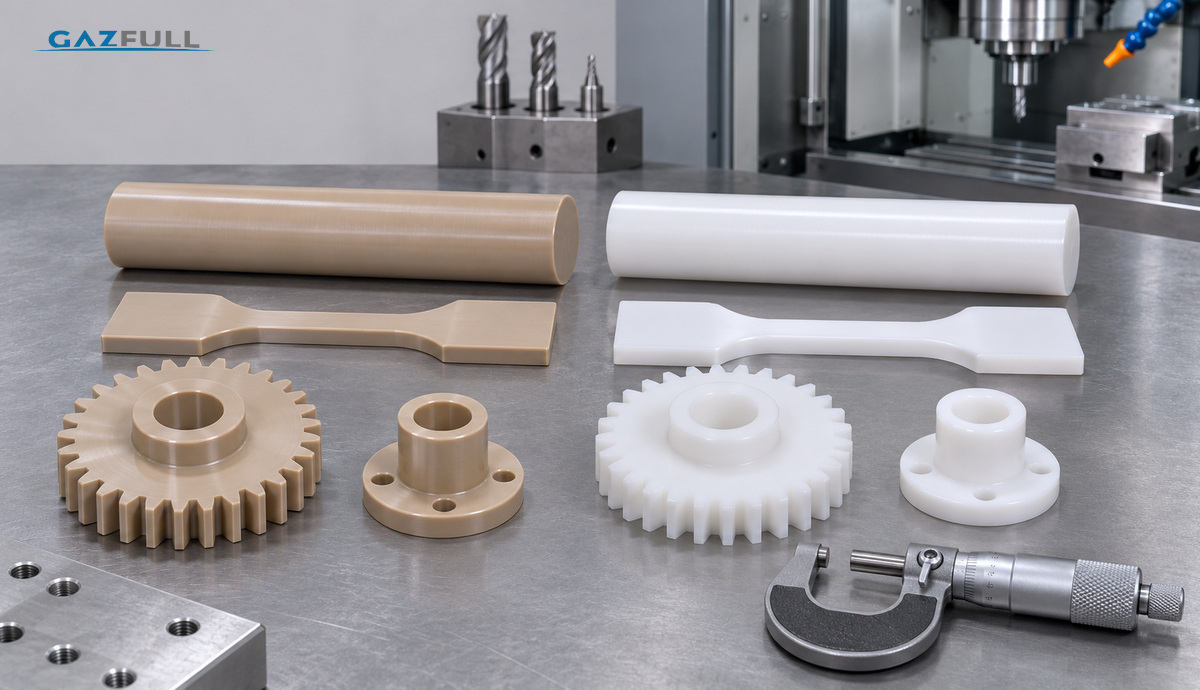
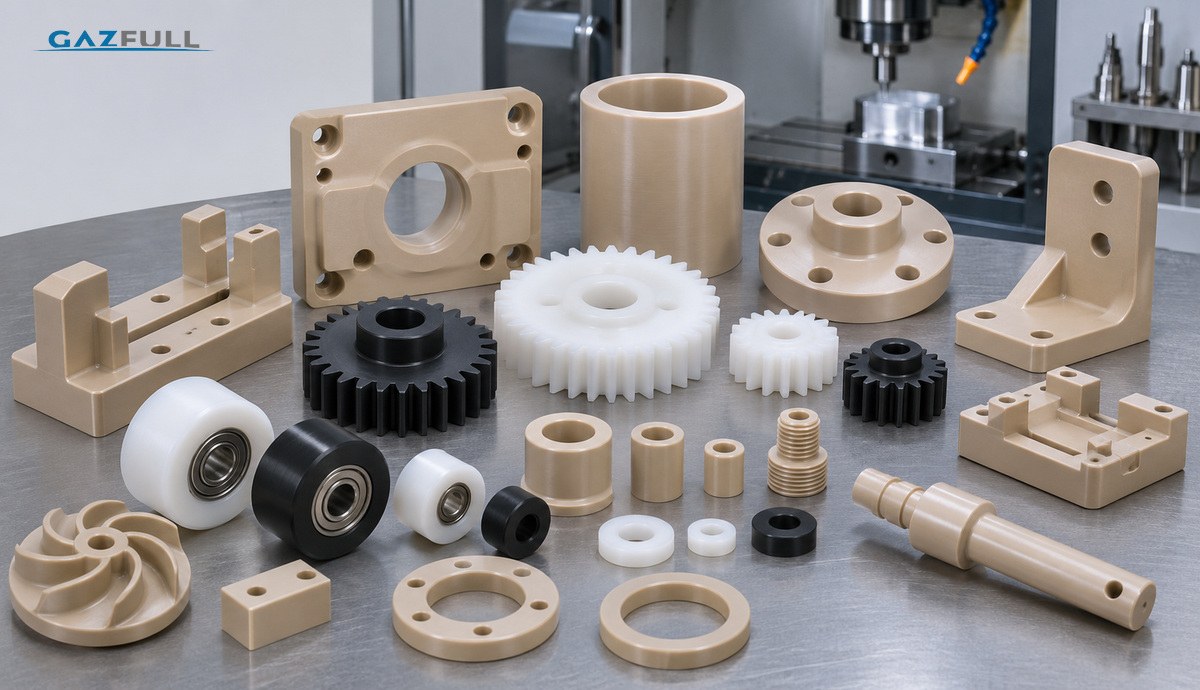
Although both PEEK and Delrin are semi-crystalline engineering thermoplastics prized for low moisture absorption and clean CNC machinability, they belong to completely different thermal and commercial tiers. Delrin (Acetal) is the universal workhorse for precision gears, low-friction bushings, rollers, and assembly fixtures operating below 85 °C (185 °F). PEEK is an ultra-high-performance polymer built for continuous service up to 250 °C (482 °F), repeated 134 °C steam autoclave sterilization, UL94 V-0 flame retardancy, and aggressive chemical or vacuum semiconductor environments.
| Engineering Property | Natural PEEK | Delrin (POM-H / POM-C) | Shop-Floor Impact |
|---|---|---|---|
| Max Continuous Service Temp | 250 °C (482 °F) | 85 °C (185 °F) | PEEK survives ovens, engines, and 134 °C steam autoclaves |
| Tensile Strength | ~100 MPa (14,500 psi) | ~69 MPa (10,000 psi) | PEEK carries ~45% higher tensile load; CF30 reaches 200+ MPa |
| Flexural Modulus (Stiffness) | ~4.1 GPa | ~3.1 GPa | Both hold crisp CNC features without rubbery deflection |
| Coefficient of Friction | ~0.30 (lower in bearing grades) | ~0.20 – 0.25 (self-lubricating) | Delrin excels for dry sliding gears, cams, and bushings |
| Moisture Absorption (24h) | ~0.10% | ~0.20% | Both stay far more dimensionally stable than Nylon (PA6/66) |
| Flame Retardancy | UL94 V-0 (inherently self-extinguishing) | UL94 HB (flammable) | PEEK meets strict aerospace and electrical safety ratings |
| Thermal Expansion (CTE) | ~47 µm/m·°C | ~110 µm/m·°C | PEEK holds ~2.3× tighter thermal dimensional stability than Delrin |
| Relative Raw Material Cost | 10× – 15× higher | Baseline (1.0×) | Only specify PEEK when thermal, chemical, or medical specs demand it |
2. Autoclave Sterilization, Chemical Resistance, and POM-H vs. POM-C Porosity
Environmental exposure is usually the clearest binary filter between PEEK and Delrin. In medical device CNC machining and biotech laboratory instruments, reusable components must survive hundreds of 134 °C pressurized steam autoclave cycles and harsh chemical disinfectants. Natural PEEK withstands over 1,000 autoclave cycles and resists virtually all organic solvents, acids, bases, and saline solutions without hydrolysis or embrittlement. Delrin degrades rapidly in continuous hot water above 70 °C, warps in steam autoclaves, and is attacked by strong acids and chlorinated cleaners.
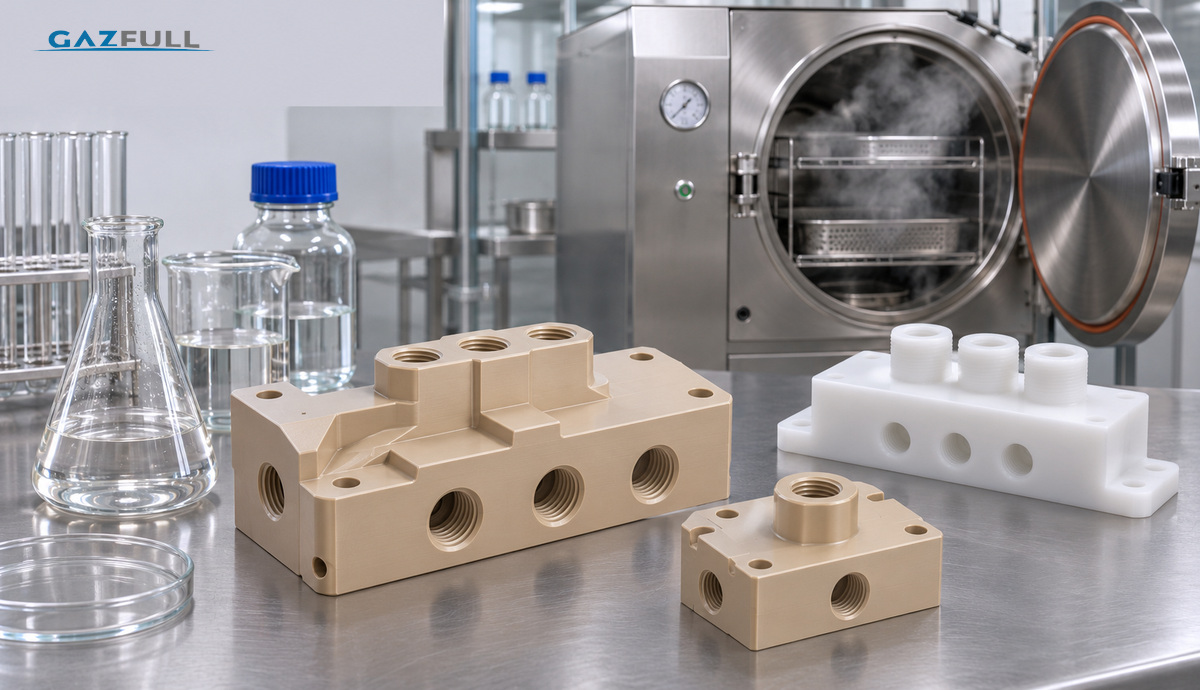
A crucial shop-floor detail missing from most generic comparisons is the difference between Delrin Homopolymer (POM-H) and Acetal Copolymer (POM-C). While brand-name POM-H offers slightly higher tensile stiffness (~10% stiffer), thick extruded POM-H rods and plates above 30 mm frequently contain microscopic centerline porosity along the core axis—which can cause fluid leaks if you machine a pressurized fluidic manifold through the center of the bar. For thick blocks, wet chemical contact, or manifold ports below 85 °C, we recommend void-free POM-C (Acetal Copolymer); for high-purity aggressive chemical or semiconductor fluidics, specify CNC machined PEEK.
3. Natural PEEK vs. 30% Glass-Filled (GF30) and Carbon-Filled (CF30) PEEK
When engineers upgrade to PEEK, choosing the exact compound grade is just as important as choosing PEEK itself. Natural (Unfilled) PEEK is the standard choice for electrical insulation, semiconductor wafer fixtures, and medical fluidic blocks where purity, toughness, and zero fiber shedding matter most. Adding 30% glass fiber (PEEK GF30) nearly triples flexural stiffness and lowers thermal expansion—ideal for rigid structural insulators operating at 200 °C. Adding 30% carbon fiber (PEEK CF30) raises tensile strength above 200 MPa, adds ESD static dissipation, and dramatically improves wear life for high-load bushings and compressor vanes.
From a CNC machining standpoint, filled PEEK grades are highly abrasive to standard carbide end mills. In our China workshop, we machine GF30 and CF30 PEEK using razor-sharp polycrystalline diamond (PCD) tooling to maintain smooth Ra 0.8–1.6 µm finishes and prevent fibrous edge fraying on fine threads and internal cross-holes.
4. Shop-Floor CNC Machining Rules: Preventing Warpage, Crazing, and Probe Flex
Delrin cuts almost like free-machining C360 brass—breaking crisp, clean chips at high spindle speeds with minimal tool wear. PEEK is also very machinable for an advanced polymer, but it retains more internal extrusion stress and builds localized heat quickly if cutters dwell or rub. In our shop, four strict manufacturing controls protect dimensional accuracy across both plastics:
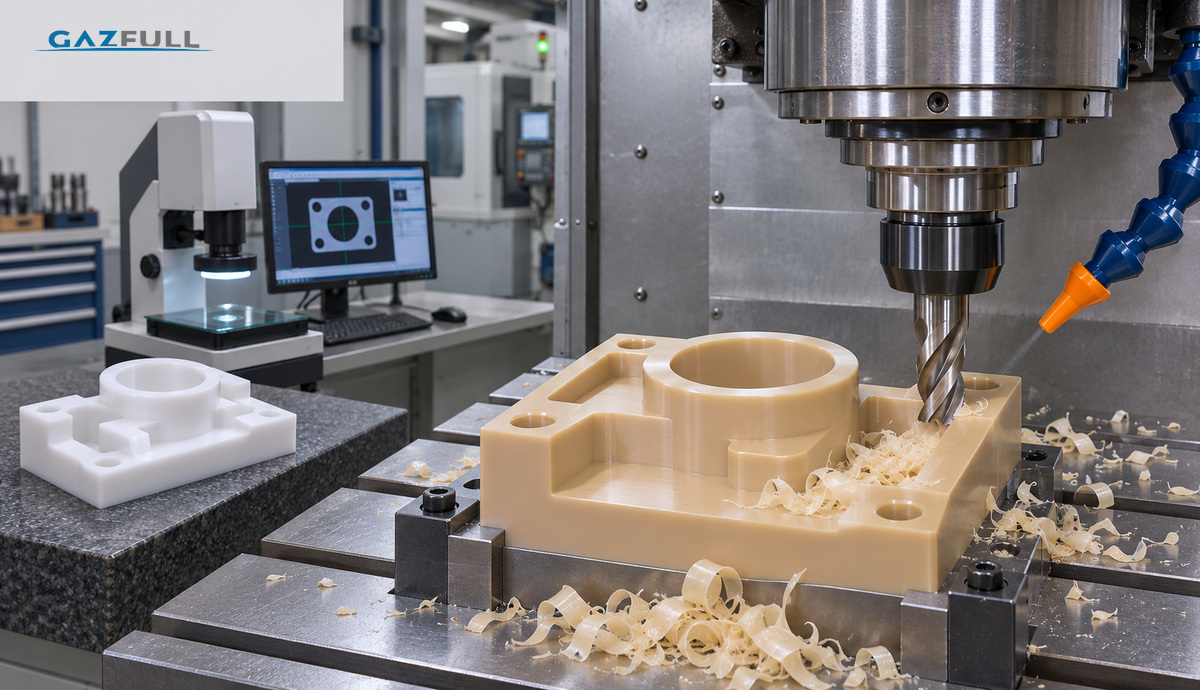
- Pre-Annealed Stress-Relieved PEEK Stock: Un-annealed PEEK can develop microscopic surface crazing or warp out of flatness after heavy pocketing. We source stress-relieved PEEK stock and run balanced rough–relax–finish sequences on tight flat plates and manifolds.
- Dedicated Polished Plastic-Only Cutters: Never cut engineering plastics with end mills that previously cut aluminum or steel. We dedicate high-rake, polished uncoated carbide (or PCD for filled PEEK) strictly to plastics, paired with clean air-blast or water-soluble coolant to shear burr-free edges without melting.
- Realistic Polymer Tolerances & Wall Thickness: Because Delrin expands ~4.6× faster than aluminum with temperature (and PEEK ~2× faster), holding metal-style ±0.005 mm tolerances on large plastic parts is physically unrealistic. Specify ±0.015 mm to ±0.025 mm on small critical bores and ISO 2768-m (±0.05–0.15 mm) on general walls, keeping wall thickness at least 1.0 mm to 1.5 mm. See our ISO 2768-f vs. tight tolerances guide for details.
- Non-Contact 2.5D Optical Vision Inspection: Standard ruby CMM touch probes can slightly deflect thin plastic walls or soft seal grooves during measurement. We inspect critical PEEK and Delrin micro-features on our non-contact optical vision system at 20 °C so reported dimensions reflect true free-state geometry.
5. Four-Step Selection Flow: How to Decide in Under 60 Seconds
Before finalizing your plastic BOM, run your component through four simple engineering gates: (1) If continuous temperature exceeds 85 °C or the part enters a 134 °C steam autoclave, choose PEEK; (2) If the part contacts strong acids, aggressive solvents, or requires UL94 V-0 flame retardancy, choose PEEK; (3) If the part runs below 85 °C as a sliding gear, bushing, roller, spacer, or assembly jig, choose Delrin (POM) to save 70%–85% on finished part cost; (4) Confirm whether POM-C copolymer (for thick void-free blocks) or CF30/GF30 PEEK (for wear/ESD stiffness) optimizes long-term field performance.
Frequently Asked Questions: PEEK vs. Delrin (POM) CNC Machining
1. How much more expensive is CNC machined PEEK compared to Delrin?
Raw PEEK bar and plate stock typically costs 10× to 15× more per kilogram than Delrin (POM). Depending on part size and spindle time, finished CNC machined PEEK parts generally cost 3× to 8× more than identical geometries machined from Delrin.
2. Can Delrin (POM) survive steam autoclave sterilization for medical tools?
No. Standard steam autoclaves run at 121 °C to 134 °C, which exceeds Delrin’s 85 °C continuous service limit and causes warping, cracking, and chemical degradation. Reusable autoclavable medical components should be machined from medical-grade Natural PEEK or Radel/Ultem.
3. What tolerances can Gazfull reliably hold on CNC machined PEEK and Delrin?
We routinely hold ±0.015 mm to ±0.025 mm on critical small bores, bushings, and mating datums in both PEEK and Delrin, with ISO 2768-m (±0.05–0.15 mm) recommended for general external dimensions due to polymer thermal expansion.
4. Should I choose Delrin Homopolymer (POM-H) or Acetal Copolymer (POM-C)?
Choose POM-H (Delrin) for thin-to-medium gears and sliding parts needing slightly higher stiffness. Choose POM-C (Acetal Copolymer) for thick machined blocks (>30 mm), fluidic manifolds, and hot-water exposure to avoid centerline porosity.
5. Why does PEEK sometimes crack or warp during CNC machining?
Internal residual stress in un-annealed PEEK stock combined with excessive cutting heat from dull tools can cause micro-crazing or bowing. Machining pre-annealed stock with sharp, dedicated plastic cutters and balanced rough-finish passes prevents cracking.
6. Can Gazfull quote the same CAD file in both PEEK and Delrin?
Yes. Send your STEP model and 2D PDF drawing and ask for a dual-material quote—we will return side-by-side PEEK vs. Delrin pricing and lead times within 24 hours so your team can compare exact cost versus performance.
Need Precision CNC Machined PEEK or Delrin (POM) Parts?
Send your 3D CAD models (STEP, IGES, X_T) and 2D PDF drawings to the Gazfull CNC engineering team today. We machine natural and filled PEEK, POM-H, and POM-C with dedicated plastic tooling and optical vision QC—delivering a transparent quote within 24 hours.